
Powering the Future of Bitcoin Mining with Zero Power Costs
Modular, efficient, and powered by zero-cost energy partnerships.
Why Bitcoin Mining?
Nigeria stands at a strategic moment where diversifying its economy, strengthening energy utilization, and participating in emerging global digital industries are increasingly essential. One sector offering significant opportunity is Bitcoin mining, a field where countries with abundant energy resources, growing tech talent, and the need for new revenue streams can gain substantial advantage.
Nigeria possesses several conditions that make this feasible: vast stranded natural gas reserves, underutilized renewable energy potential (solar and hydro), a rapidly expanding digital-native youth population, and a pressing need to monetize energy resources more efficiently. Much of Nigeria’s natural gas is currently flared due to infrastructural limitations; Bitcoin mining offers a way to convert this wasted resource into economic value immediately. Additionally, as global mining increasingly shifts toward regions with cheaper energy and favorable climates, Nigeria can position itself as a competitive player in Africa’s emerging crypto-energy landscape.
Bitcoin mining itself is the process by which transactions are officially entered onto the blockchain: a decentralized digital ledger that securely records transactions in a chain of “blocks.” Once added, each block is permanently linked to the previous one, creating a transparent and tamper-proof history of all activity—since altering a single block would require changing every subsequent block across the network, an effectively impossible task.
To participate in this system, miners use specialized hardware and software to generate cryptographic numbers that must meet the target set by Bitcoin’s difficulty algorithm. The first miner to find a valid solution receives newly minted bitcoins as a reward, after which the process begins again. Because the probability of winning a block is proportional to a miner’s computing power (hashrate) relative to the entire network, miners often collaborate in pools to increase their chances of earning rewards.
For Nigeria, entering this space is not just about mining digital assets—it represents a broader opportunity to convert excess energy into revenue, attract foreign investment, stimulate technology adoption, and position the country as a continental leader in a rapidly growing global industry.





Key Value Proposition
Zero-Cost Power Model
Flexible Modular Deployment
Optimized Revenue Strategy (80% sold monthly)
Industry-Leading Efficiency (16.95 J/TH)
Market Opportunity
Cryptocurrency has moved firmly into the mainstream of global finance. Around the world, major economies are providing clearer regulatory definitions for digital assets, recognizing them as legitimate components of the financial system and integrating them into broader economic frameworks. This shift has accelerated institutional involvement, boosted market confidence, and expanded the overall digital asset ecosystem into a multi-trillion-dollar industry.
As global financial infrastructure evolves, payment networks, financial service providers, and technology platforms are increasingly incorporating digital assets into everyday transactions, treasury strategies, and cross-border settlement systems. This signals that cryptocurrencies and their underlying technologies are no longer speculative novelties but foundational elements of an emerging digital financial architecture.
For Nigeria, these global developments create significant new opportunities. Domestically, Nigeria already has one of the highest rates of crypto adoption, driven by a youthful, digitally literate population and strong demand for alternative payment and savings tools. Clarifying global norms provides Nigerian entrepreneurs, fintech companies, and financial institutions with a more stable environment to build products in areas such as payments, remittances, asset management, and digital trading infrastructure.
Globally, Nigeria is well-positioned to become a competitive hub in several high-growth segments of the digital asset economy, especially in Bitcoin mining and energy-backed digital infrastructure. With substantial natural gas reserves, untapped renewable energy potential, and widespread challenges related to energy monetization, Nigeria can convert stranded or underutilized power into economic value by hosting mining operations and exporting compute power to the global Bitcoin network.
Beyond mining, Nigeria can leverage its talent, market size, and regional influence to develop capabilities in blockchain development, custodial services, fintech innovation, and digital asset regulation—positioning itself as a leader in Africa’s emerging digital economy.
$4 trillion crypto market cap (2025)
Stablecoin volumes surpassing Visa
Mastercard + USDC integration
$33 trillion transactions past 12 months
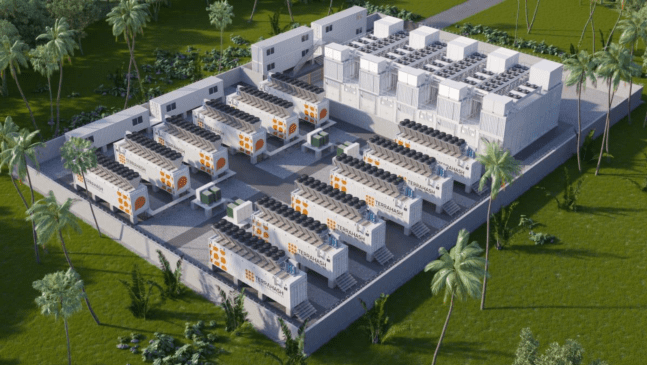
The Terrahash Advantage
Terrahash VS Global Average
Site Efficiency: 16.95 J/TH VS 25–30 J/TH
Miner Efficiency: 58.8 TH/kW VS ~36.4 TH/kW
Pool Fees: Nil VS Paid